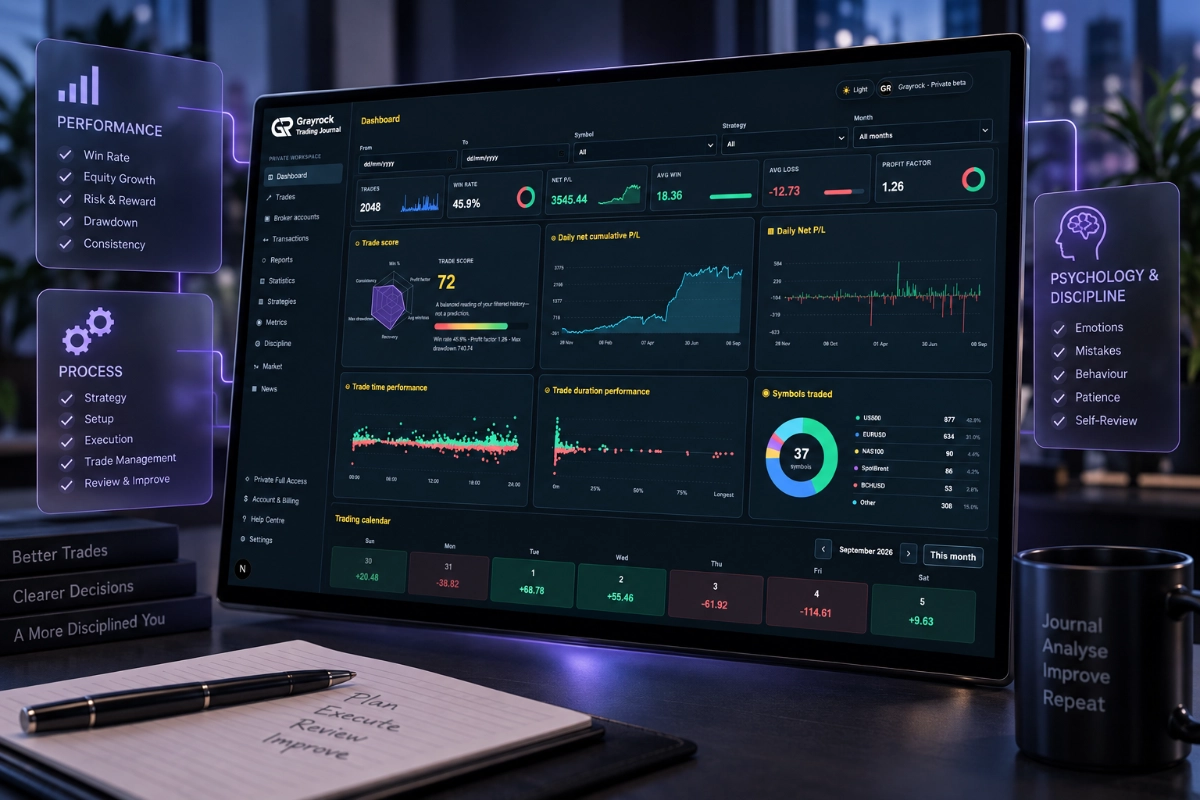
Trading Journal: Beyond Profit & Loss
Intro
Profit and loss tells you what happened financially.
It does not necessarily tell you whether a trade followed a good process, whether the setup matched the trader’s strategy or whether the same behaviour is being repeated over time.
A useful trading journal therefore needs context beyond the final result.
Profit and Loss Is an Outcome
A profitable trade is not automatically a good trade.
A trader can break a rule, take unnecessary risk and still finish with a profit.
Likewise, a losing trade is not automatically a bad decision if the setup and execution followed a valid process.
That distinction is one reason structured review matters.
Performance
Performance data helps describe the measurable outcome of trading activity.
Useful information can include:
- win rate;
- profit and loss;
- risk and reward;
- strategy performance;
- instrument performance;
- trading sessions;
- performance trends.
Process
The journal should also capture how the trade was approached.
That can include:
- strategy;
- setup;
- entry reasoning;
- trade management;
- whether trading rules were followed;
- mistakes or deviations.
Psychology & Discipline
Trading behaviour can influence decision-making.
Recording discipline, hesitation, impulsive actions and other relevant observations can help traders identify recurring behavioural patterns alongside performance results.
Context Turns Trade History Into a Journal
A list of entries, exits and profit or loss is trading history.
A journal becomes more useful when those records include the context needed to understand why a trade was taken and how it was managed.
Review Patterns, Not Just Individual Trades
One result should not necessarily determine whether a strategy or process is working.
Structured history allows traders to review repeated patterns across strategies, setups, sessions, decisions and behaviour.
Build a Repeatable Review Process
A practical review process can be summarized as:
Record → Add Context → Analyse → Review → Improve
The objective is not to predict the next trade. It is to understand the trading history that already exists.